Amidst this chaotic time, our existing assets are once again one of the most important pillars of sustainable business strategy. How we manage those assets is increasingly signaling the difference between success and failure.
Why now is the right time to invest in asset and maintenance management
A decade ago, capital spend on new equipment was big and there was only back-burner interest on planning for long-term asset and maintenance management.
In the past few years, we've reached the point in the economic cycle where things have started to slow and stabilize. Our assets are maturing and we need to switch our efforts from expansion to maintenance. We need to start taking better care of what we've got to ensure we can continue to perform well in this part of the cycle.
Establishing a proactive Asset and Maintenance Management (AMM) program is particularly prudent given the challenging times we find ourselves in. The global coronavirus pandemic has dealt a heavy blow to economies and industries around the world. Many companies won't survive it. Those that do survive may need to radically rethink the way they do business.
For asset-intensive industries, proper AMM is an important component of building the kind of business resilience we need to handle such unexpected external impacts.
In a previous article, we discussed some steps to building a value-oriented AMM process as well as some low-capital levers to achieving maximum gain from minimal investment. In this article we'll zoom out to examine the AMM maturity curve and what fundamental shifts in thinking are required to move along it to achieve long-term sustainability.
Understanding your position on the AMM maturity curve
We see many businesses today conducting asset maintenance reactively, dealing with problems as they arise. If we were to place this approach on an AMM maturity curve, we'd call it first generation AMM.
Some problems with this phase are that it's costly and unsustainable in times of crisis. Frequent down time, an erosion of asset productivity, and a shortened asset lifespan are characteristics that lead to both immediate and long-term loss of profitability and value. Businesses stuck in this phase are not adequately equipped to deal with unexpected internal events, let alone external ones.
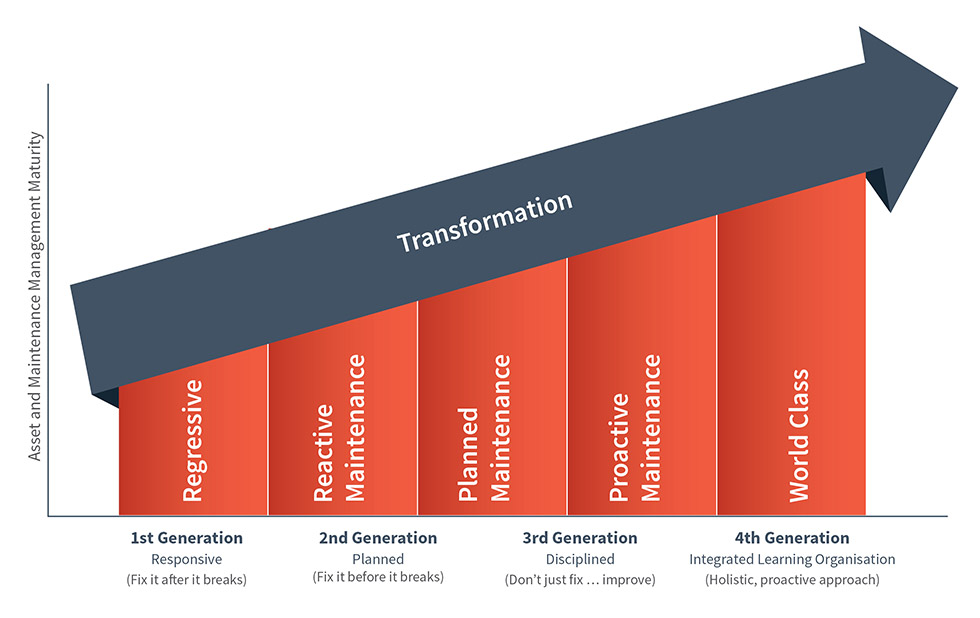
The goal for organizations to achieve a level of business resilience that can predict a sustainable future is to move from first generation into planned (second) and proactive (third) generations. World-class (fourth) generation asset and maintenance management may also be within reach for some organizations.
In the fourth generation, businesses have achieved total department integration where asset maintenance is everybody's business. It's baked into both the strategy and culture of an organization. Instead of fixing assets as things go wrong, we're improving them ahead of time and leading the industry in AMM innovation. We have achieved a world-class level of business resilience and sustainability.
While the principles of a maturity curve and the need to move along it are evident enough, how to apply the right approach to actually make it happen isn't always obvious.
What it takes to move from reactive to proactive AMM and beyond
We've helped many clients move up the AMM maturity curve, but it takes several key shifts in thinking for business leaders as well as plant and fleet managers and workers:
- Understand and accept the need for change. When your organization has been operating in one way and achieving an adequate level of performance for some time, it can be hard to recognize a need fro big changes. Getting AMM right involves making big changes, and this is difficult for everyone from managers to maintenance workers within your organization. While it may seem a long way from asset maintenance, a proper program of change management is a critical component of moving your organization up the AMM maturity curve.
- Move from an incremental to a holistic perspective. While many operations may believe that incremental changes like cleaning up existing maintenance strategies represent a progression of their AMM, such activities do nothing to move your operation beyond its current reactive phase on the maturity curve. Business leaders need to shift from incremental to holistic thinking, consider the whole framework, and understand that proper AMM involves initiating a comprehensive work program to move from one stable phase to the next. This transformation program means planning and acting on all aspects of AMM, including strategy, processes, behaviors, systems, and facilities. This is a comprehensive work program, but if managed as a project it can be executed in a matter of months.
- Know when to work with an experienced partner. While critical asset maintenance should ultimately be owned and executed by internal teams, establishing a proactive AMM program requires undergoing a significant organizational transformation. Such an undertaking should be done in collaboration with an experienced external partner who can accelerate your time-to-value, establish the right change management approach, and shepherd you through a tightly-orchestrated holistic program that will integrate everything from IT systems to leadership.
Next-generation AMM is within reach for most businesses
Achieving planned and proactive AMM is not an insurmountable hurdle.
One client responsible for a large mobile fleet in Australia hit their biggest Aha! moment when they realized their AMM approach needed a massive overhaul, but they couldn't do it alone.
Instead of continuing to erode business value, suffer increasing risk and safety incidents, and jeopardizing their organization's resilience, they asked us to partner with them to move from a reactive to a proactive level of AMM maturity.
Following the transformation, the company's fleet safety incident rate dropped dramatically. We estimate the impact to be 14% in cost reduction per year in the medium term. With their holistic program approach, they're also well equipped to handle unprecedented emergencies such as bushfires and pandemics.
With the right approach, a commitment to transformative change and collaboration with an experienced partner, many of our clients have unlocked unprecedented value in their organizations and secured a sustainable future for their assets and their business.